
The Missing Dimension: It's Time to Update IDEO's Favorite Hiring Model

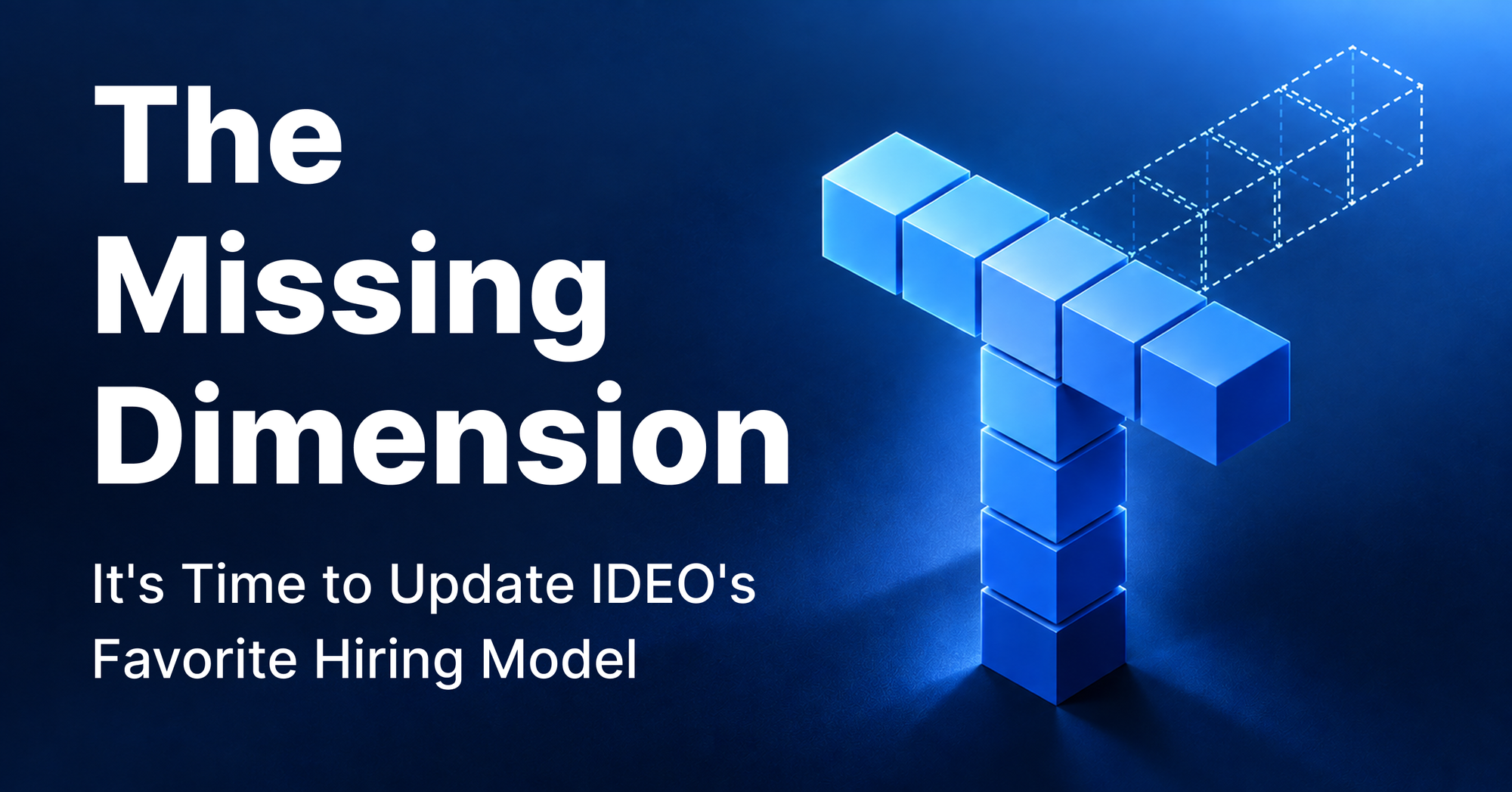
For thirty years we've hired for depth and breadth. There's a third axis we've been missing, and mapping all three reshapes the T from the “T-shaped person” into the Fluency Cube, the visualization of what I've come to call "operational fluency."
I'm hiring two product designers right now. That means I've spent the last few weeks writing job descriptions, creating an expectations matrix for each role level, and trying to put real words to what would make someone great at these roles. Through all of it, I keep ending up describing something close to what IDEO calls a "T-shaped" person: someone who has depth of craft, but who also has a working knowledge of the functions they collaborate with regularly.
That said, I find the T-shape comes up a bit short when I'm assessing someone's operational or leadership effectiveness. There's a third axis worth considering alongside depth and breadth, and I think it's a worthy extension to the T.
First, what is a "T-shaped person"?
For a long time, we judged someone's potential almost entirely by who was best at the craft, or who had been doing it the longest. Best engineer becomes the engineering manager. Longest tenured designer runs the design team. If you were seen as someone with a lot of range in your specific professional domain, you were considered leadership material, and for the most part it worked fine. I'll refer to this range as domain fluency.
Then work became a lot more collaborative and cross-functional, and we started to find that it wasn't just depth of craft and tenure that mattered, but also someone's ability to understand and interface with the adjacent functions they worked with. Think of the designer who understands how the code gets written, or the engineer who understands the customer and their pain points on top of the architecture they build with.
This is what led David Guest to name the "T-shaped person" concept in 1991, and led Tim Brown of IDEO to popularize it by using it to hire (though McKinsey was reportedly using "T-shaped" internally back in the 1980s). It became the shape by which many people, knowingly or unknowingly, measured great talent in a cross-functional world.
And, like domain fluency, it isn't about a static level you operate at. The T is meant to signify the range across which you are fluent on each axis. Since breadth is the lateral line in the T, I'll call this lateral fluency.
But something is still missing.
The missing third axis
When I consider what the T-shape looks like for different roles, I see an unexplained gap. A designer's domain fluency is likely measured by the quality of their mockups or their knowledge of accessibility rules, and their lateral fluency by their understanding of how a ticket is written or what technical constraints to design within.
But a Chief Design Officer's domain fluency is likely measured by their grasp of a design system or what makes a cohesive brand identity. Their lateral fluency may be more about their understanding of what outcomes would make a marketing campaign a success, or how a design decision will affect the sales team's quarter.
These people are both T-shaped, and both designers. But the main difference between them is the altitude at which each is expected to operate, or the strategic context they work within.
This is what I call context fluency, the missing third axis.
Context fluency adds the crucial missing third axis to the T-shape concept.
And even though we typically expect people to operate at the altitude relevant to their title, I believe the larger a person's strategic range, the more effective they are, regardless of their title. Being able to see the broader strategy makes the designer better at the detail level, and being able to understand the details makes the CDO better at the strategic level.
The next evolution of the T
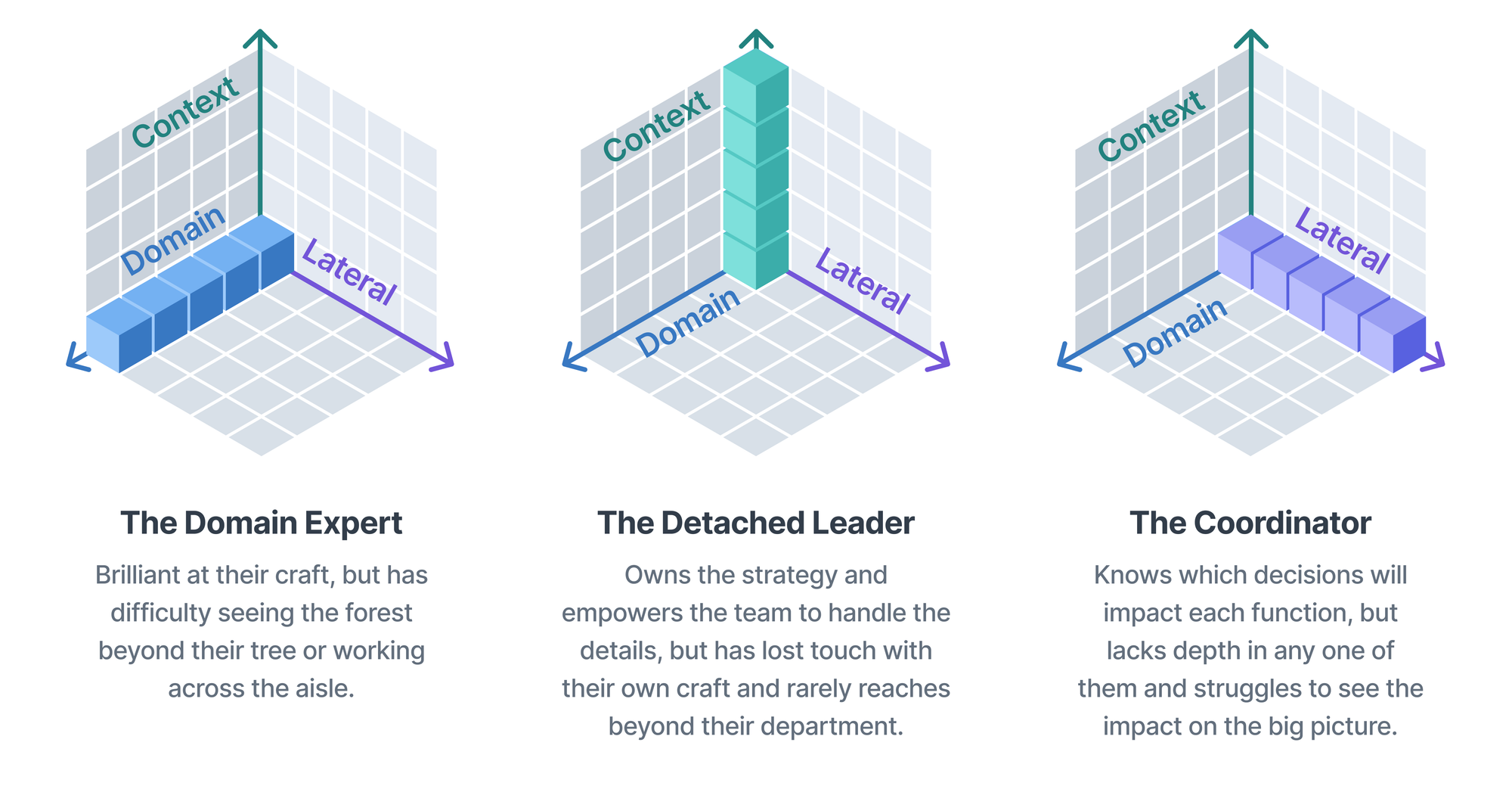
Now that we have three axes, and our goal is to visualize someone's overall range, or fluency, the obvious move is to turn the T into a cube and picture someone's operational effectiveness as a volume. The most fluent person isn't the one who operates at the single fixed point their title requires. It's the person who fills the most space in the cube.
Here are a few shapes you have probably worked with:
The leadership training gap
Going back to the days when depth of craft was the biggest indicator of leadership potential, we seem to have poured almost all of our effort into training the relational side of the job. I've been in countless management trainings and classes, and almost every minute was spent on how to delegate work, how to have difficult conversations, how to read different communication styles, how to set appropriate employee goals, and why regular 1:1s matter.
Now, don't get me wrong. This part of leadership is important, I've gotten a lot of value from these courses, and I appreciate the people who have taught them.
And the relational part of leadership is only half of the equation. Where is the training that develops someone's ability to operate at, and move between, different altitudes, rather than just the one their title assigns them? Right now it feels like we assume some people have it and some don't, or that people should pick it up naturally over the course of their career. But tenure is a poor measure of this capability.
The Seniority Paradox
Many people assume a senior leader will naturally be more effective than a junior contributor, because they've worked their way up the corporate ladder and have more years of experience. Yet in my 20 years in this industry, and the 20-plus companies I've worked at or consulted for, I've seen too many cases where seniority is only weakly correlated with effectiveness. I believe this is directly related to the leadership training gap.
Consider these two profiles.
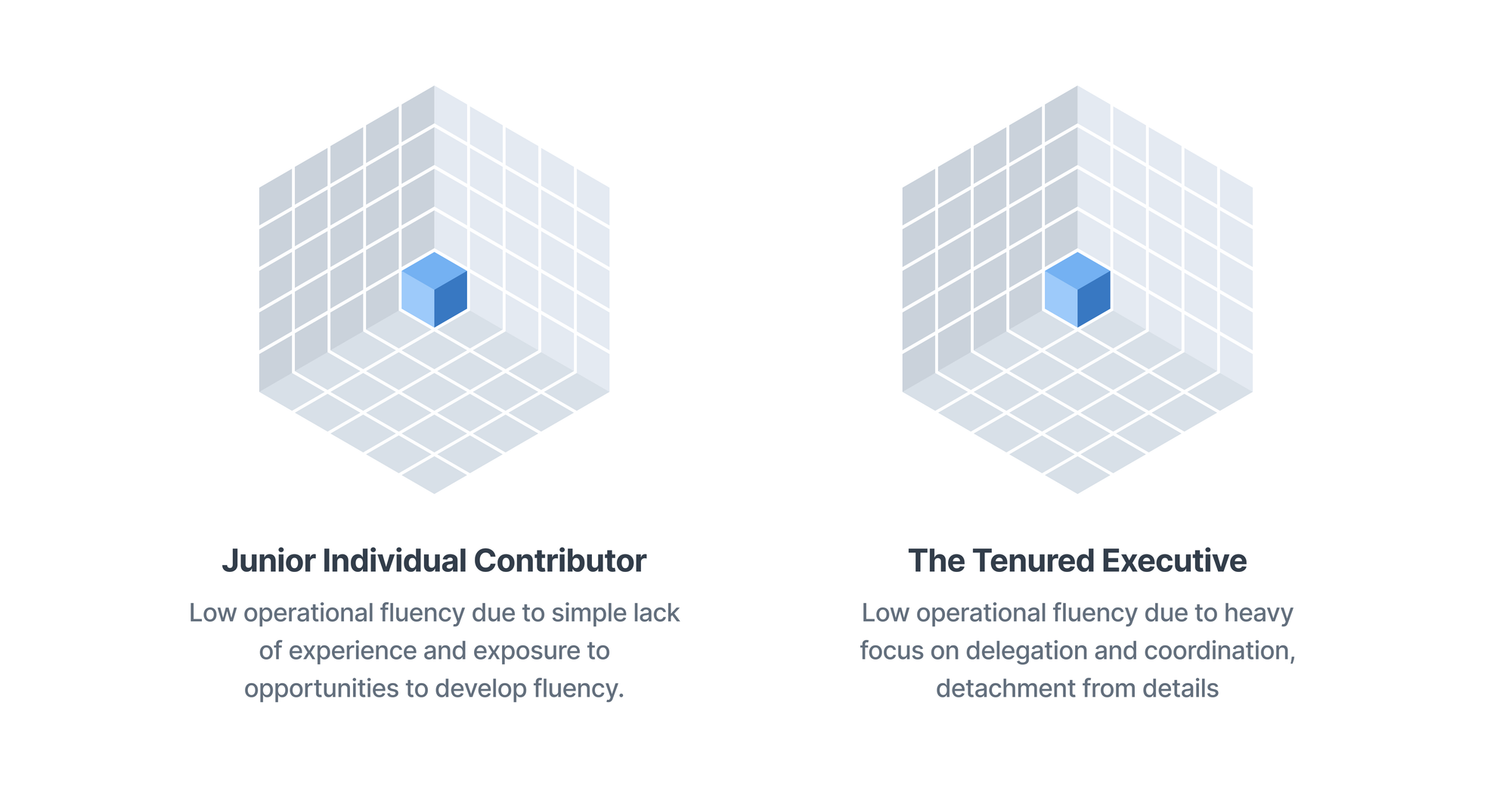
A junior individual contributor's cube is barely filled in. That's because they have very little range in their domain yet, and not enough experience to have built much lateral or context fluency.
But now consider the cube of a leader in that same domain. They have very likely been trained to focus on people and relationships and to delegate most of the actual work, leaving them a bit out of touch with the nuances of their domain after years of not getting their hands dirty. They likely spend their time with leaders of adjacent functions who are similarly detached from their functions, and only discuss things at the thirty-thousand-foot "strategic level" befitting their title.
These are the leaders who end up well liked and well respected, but can still be ineffective at getting the results they're tasked with. Empowering a team to be successful isn't just making sure they feel heard and supported. It's also setting clear operational direction for the desired results, setting the standard those results are held to, being fluent enough in the work to assess whether the team is actually delivering to that standard consistently, and to provide the right direction for developing the people who aren't there yet.
When leaders feel ill-informed about the details needed to make strategic calls, they push those decisions down to their teams. This is often done in the name of "empowering their people," but it can end up setting those people up for failure, asking them to possess knowledge and skills they may not have yet.
The best leaders I've worked with keep a pulse on the details needed to make sound strategic decisions, and then apply those details at a much higher level. Even if they aren't sitting in on the sales calls, reading the support tickets, or attending the design reviews themselves, they find ways to absorb what gets discussed. That makes their strategic decisions defensible and grounded, and it helps build a shared understanding across the team that unifies direction and momentum.
Introducing operational fluency
I call the culmination of domain, lateral, and context fluency someone's "operational fluency," and we visualize it inside the Fluency Cube. For now it's an abstract picture meant to represent the concept, but I hope to develop ways to actually measure it in the future.
As for developing the fluencies themselves, it's really just about investing in the areas where you're weakest. Consider an athlete. They often have benchmarks across a variety of fundamentals that they measure and invest in as needed. Maybe endurance is strong but speed is lacking, or reflexes are sharp but strength is lower than they'd like. An athlete develops these fundamentals to give themselves the strongest base to perform from on game day.
The same is true in business, but we've never really had a way to confidently identify the areas we need to invest in. With the Fluency Cube, we get a clearer idea of what to work on. Weak in lateral fluency? Set up time for someone in the relevant functions to explain things to you, listen to a podcast, or read a book about it. Feel like you lack context fluency? Attend senior leadership office hours, ask your leader to help explain the bigger picture, or go listen to a talk from a prominent leader in your field.
To be clear, I don't expect anyone could actually fill the cube perfectly across all three axes. The point isn't to fill the cube. It's to use it as a compass for where to invest your growth most effectively. I fully expect that as you develop one fluency, you may find you need to re-strengthen the others.
And for leaders, it can also serve as a guide for who to pair up. Putting two people together who are both strong in domain fluency, where one also brings strong lateral fluency and the other strong context fluency, will likely beat pairing two people who are both strong in domain and context but weak in lateral.
What is your experience?
I believe operational fluency matters well beyond leadership. I've already seen it become a major factor in who's effective with AI tools, but that's a post for another day.
For now, I'd love to hear how this concept tracks with your experience, and how useful it may or may not be for you. Have you observed the seniority paradox? Have you felt frustrated by the lack of training for how to become more effective operationally? Let me know.
Thoughts about this post? Have follow ups or other topics you want to hear about? Let me know! I am less motivated to write posts in a vacuum and appreciate the discourse around the topics I write about. Subscribe to the newsletter, hit me up on LinkedIn or X.com, and let me know what you think.